 CARLOS DIEGO C. P.
SaaS Factory (The Series) · Part 1 of 2
SaaS Factory — The Series: SaaS 3.0 Business Practices (Part 1/2)
In this post, we will talk about SaaS 3.0 Business Practices: Building and Optimizing a Modern SaaS Company.
Keywords
In this post, we will talk about SaaS 3.0 Business Practices: Building and Optimizing a Modern SaaS Company.
The Software as a Service Model
The software as a service (SaaS) delivery model is being adopted more and more by companies, especially startups. The idea of going to market ASAP (as soon as possible) demands a complete focus on the product. In this context, the infrastructure and product delivery layer needs to account for a broad spectrum of agility, innovation and operational efficiency. And along this path, SaaS creates a whole range of new competitive advantages for companies, opening up new opportunities to grow their business, since exponential scalability will not — necessarily — be a bottleneck.
To support this journey, the AWS SaaS Factory program proposes a practice model that aims to guide companies, both in terms of patterns and of strategies for turning other businesses into SaaS. The model helps companies prepare for the transformation through four phases, as shown below.
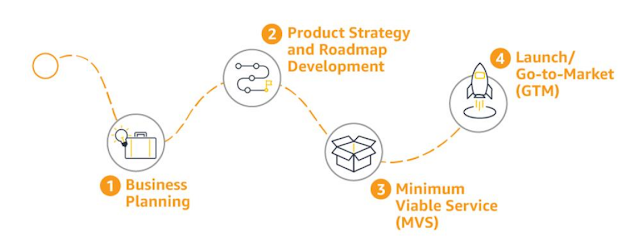
SaaS Factory presents a dynamic work process that is not necessarily linear. It is clear, however, that four macro activities will invariably make up the big picture: 1) Business planning; 2) Product strategy and development path; 3) Minimum viable service (MVS); 4) Launch and go-to-market (GTM).
Company Profiles
Drawing on its experience implementing the model, AWS has found that companies building software as a service solutions usually fall into four different types of organizations. Naturally, this is not a rule without exceptions, but most companies certainly fit one of these profiles.

ToeDipper Software
This profile represents large, conservative companies that usually run a legacy product held back by old technology or processes, but that have a captive, profitable market. This company represents mature businesses that often have a firm grip on a market that generates significant revenue, but that does not aggressively demand SaaS for industry, regulatory, geographic or cultural reasons.
SurvivorTech
This company profile represents businesses that have a product but are watching their market being eroded by competitors that have used price, agility or cost efficiency to win the market.
UnicornExpress.com
This company profile represents greenfield SaaS companies — with a SaaS solution built from scratch — that are blazing a trail into SaaS without the baggage of an existing legacy environment.
New Horizons Software
For this company profile, the move to a SaaS model is more about identifying and exploring new market segments that are not served by its existing offering. The focus here is to use the opportunity to make this move to a new SaaS offering that targets a set of features and experiences that are not part of the current offering.
In the next post, we will talk about how to carry out the business strategy process for a SaaS model, looking at each of the four macro activities laid out in the SaaS Factory model.
SaaS Factory (The Series) — How to Build Software as a Service Solutions on AWS
See you then! =)
Comments
Every comment is moderated before it appears here. Nothing is published automatically.
Loading…