 CARLOS DIEGO C. P.
SaaS Factory (The Series) · Part 2 of 3
SaaS Factory (The Series) — Data Partitioning: Storage Strategies in SaaS (Part 2/3)
In this post, we continue talking about data partitioning architectures: storage strategies in SaaS.
Keywords
In this post, we continue talking about data partitioning architectures: storage strategies in SaaS.
Storage scalability and operational overview
One of the goals of data partitioning strategies is to minimize operational costs and administrative complexity. AWS storage services address the key SaaS needs when it comes to storage scalability:
- Built-in mechanisms for high-availability protection;
- Granular ability to tune IOPS;
- Ability to configure data backups and snapshots;
- Support for a variety of partitioning schemes;
- A broad spectrum of storage services to fit different solution profiles;
- Ability to balance the cost profile against storage demands.
How do you establish a storage strategy in SaaS?
Selecting a multi-tenant storage and partitioning strategy is influenced by many different factors. If you're migrating from an existing solution, you may favor a silo model because it offers the simplest, cleanest way to transition to multi-tenancy without rewriting your SaaS application. If you have regulatory or industry dynamics that demand a more isolated model, the efficiency and agility of the pool model may still unlock your path to an environment that embraces fast, continuous releases. The key here is to recognize which strategy you should select and how that choice will be driven by a combination of business and technical considerations in your environment.
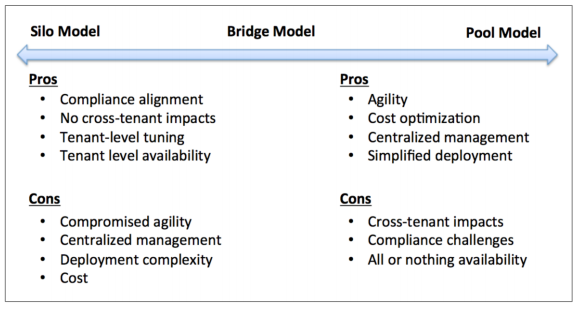
Pros and cons of each multi-tenant partitioning model
If you placed the three partitioning models — silo, bridge and pool — on a spectrum, you'd see the natural tensions associated with adopting any one of these strategies. The qualities listed as strengths for one model are often represented as weaknesses in another. For example, the principles and value system of the silo model are often in opposition to those of the pool model.
Pros and Cons of the Silo Model
Pros
- Silo is appealing for SaaS solutions that have regulatory and security constraints;
- Cross-tenant impacts can be limited;
- Availability is managed at the tenant level, minimizing tenant exposure to outages;
Cons
- Provisioning and management are more complex;
- Your ability to view and react to tenant activity is impaired;
- The distributed nature of a silo model affects your ability to effectively analyze and assess performance trends across tenants;
- Silo limits cost optimization.
Pros and Cons of the Pool Model
Pros
- Agility;
- Storage monitoring and management are simpler;
- Additional options help optimize the cost footprint of your SaaS solutions;
- Pool improves deployment automation and operational agility.
Cons
- Agility means a higher level of scale and availability management;
- Pool challenges the management of tenant data distribution;
- The shared nature of the pooled environment may meet resistance in some domains.
Hybrid approach
In some cases, a subset of your tenants may require the silo model while others fit the pool model. One possible path is to build a solution that supports both the Silo model and the Pool model. In these cases, you can create a separate database for the tenants that require a siloed storage solution, while sharing one among those that support a pooled context.
In the next post, we'll continue talking about data partitioning architectures: storage strategies in SaaS.
SaaS Factory (The Series) — How to Build Software as a Service Solutions on AWS
See you then! =)
Comments
Every comment is moderated before it appears here. Nothing is published automatically.
Loading…