 CARLOS DIEGO C. P.
Essay · Computing
Product Management: Balancing the Feasible, the Viable, and the Desirable
Keywords
Overview
After nearly 22 years of a career spent mostly on technology and engineering teams, I am going through a phase that is thrilling but equally demanding: together with our team, I am working to transform our company — which has been focused mainly on services — into a company that also builds products. This means that, in addition to continuing to offer Cloud Computing consulting services, we are working to develop our own products and bring them to market.
Naturally, this shift is far from trivial. We are taking on the task of creating a new business model and of adjusting the mindset of a team accustomed to the services model so that it begins to think like product builders. That involves new ways of working, more collaboration, and a great deal of experimentation in order to create something that genuinely makes a difference for our customers.
This kind of challenge is quite common for companies that, like Valcann, seek to diversify and enter new markets. Often the greatest obstacle is figuring out which product to build and making sure it truly solves a problem that matters to customers. For those of us who work in consulting, problems are the one thing we never run short of!
So we have been looking within our own reality for the challenges that are worth solving with products. But that is not all: we also need to adjust our entire internal structure to support this new direction. This includes investing in research, building prototypes, testing quickly, listening to customer feedback, and adjusting the product with agility... All of it with the hourglass of the “Investments” budget line already turned over. It is a path that demands patience and flexibility, but also a great deal of responsibility and a passion for the problem rather than for the solution — after all, we may need to abandon a solution and look for another when it fails to address the challenge we identified.
This is where product management has come in as a cornerstone. With it, we have been able to align our goals with the needs and the skills of our team. In our day-to-day work, we have been applying practices such as continuous validation, feature prioritization, and iterative development to ensure that our products are truly wanted by customers and viable for the company.
But what challenges have we been facing?
In product development, especially in highly competitive and innovative environments such as Cloud Computing, striking the right balance between what is feasible, viable, and desirable is possibly the central challenge. And it has been no different in what we are facing in our product development unit at Valcann.
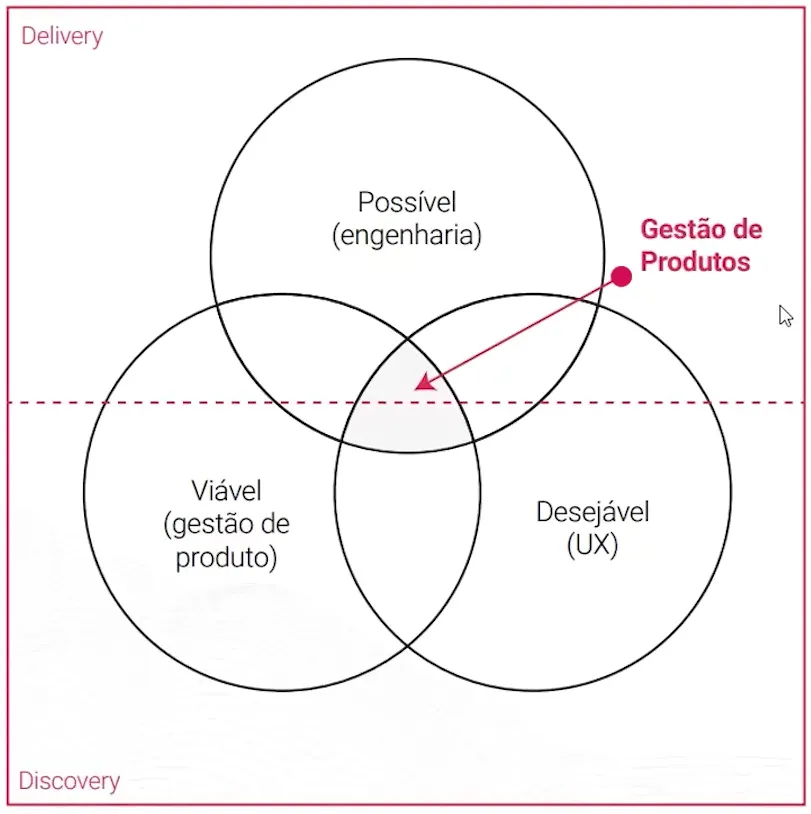
What Do “Feasible,” “Viable,” and “Desirable” Mean?
Feasible (Engineering): This element concerns the technical feasibility of a product or feature. The central question here is: “Can we build this?” It involves analyzing the capabilities of the technology and of the team, as well as weighing constraints such as time, resources, and technical complexity. The engineering team must ensure that the product is built in an efficient, sustainable, and scalable way.
Viable (Product Management): This is about business viability. Here the question is: “Should we build this?” It involves assessing whether the product or feature makes economic and strategic sense for the business. Considerations such as cost, revenue potential, target market, and strategic alignment are fundamental. Product management must ensure that the development effort yields a positive return on investment (ROI).
Desirable (UX — User Experience): Here we assess how attractive and usable the product is for its end users. The question guiding this area is: “Do users want this?” It involves a deep understanding of users’ needs and desires, ensuring that the product is not merely usable but also desirable. The UX team conducts research, builds prototypes, and runs usability tests to validate these hypotheses.
The intersection of these three circles represents the “sweet spot” of product management — the point at which the product meets technical, business, and user requirements. This is where the greatest potential for success lies.
Discovery and Delivery: Making It Happen
When we talk about “making it happen” in product development, there is one essential concept: Dual Track.
Dual Track is a product development approach that splits the work into two parallel tracks: Discovery and Delivery. The core idea behind Dual Track is that, rather than treating discovery and delivery as sequential phases, these activities happen at the same time, allowing teams to be more agile and to respond quickly to change and to new information.
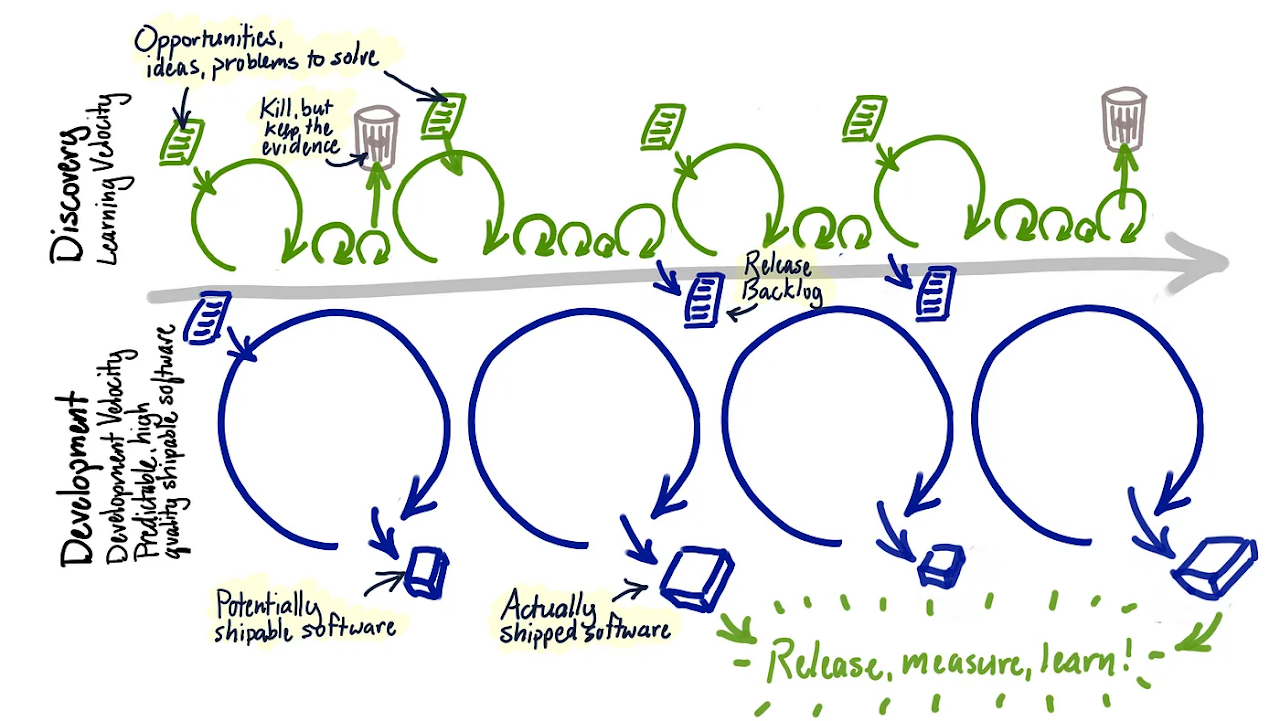
On the Discovery track, the focus is on deeply understanding the problem that needs solving, exploring users’ needs, and identifying possible solutions. Here the team is testing ideas, building prototypes, conducting user research, and validating hypotheses. The goal is to make sure that what is being planned is truly wanted by users and will meet the needs of the business. It is a phase of intense experimentation, in which failures are welcome because they help us learn quickly what works and what does not.
Meanwhile, on the Delivery track, the team is busy turning those validated ideas into a working product. Here the focus is efficient execution: building, testing, and launching the product with quality, on schedule, and within budget. The beauty of Dual Track is that the two tracks are constantly feeding each other. Findings from the Discovery track inform and adjust the Delivery work, while feedback from delivery can carry new questions or ideas back into Discovery. This integrated approach makes product teams more dynamic and able to adapt their strategies quickly, ensuring that the final product is something users genuinely want and need.
This approach has been fundamental for us, helping us keep our team working in an integrated way across design, engineering, and product management (both with respect to the original roadmap and to the new demands and features that emerge as we ship the software).
And the challenges?
Implementing these concepts in an integrated way is not simple and comes with a series of challenges. First, there is the need for alignment across teams. For everything to work well, the Design, Engineering, and Product Management teams must be on the same page, sharing information and working together toward the same goals. That demands constant communication and routine — dailies, weeklies, and as many ceremonies as necessary — along with a healthy dose of collaboration to make sure no one is left behind and everyone is headed in the same direction.
There is also a challenge common to engineering contexts: prioritizing resources. With time and money always limited, deciding where to invest can be a complicated task. It takes a lot of negotiation and a steady focus on what truly brings the most value to the product and to the end user.
We have also been striving to adapt to market changes, since what matters today may no longer matter tomorrow. We want our teams to be agile and ready to change course should new evidence appear. And, of course, we cannot lose sight of a continuous focus on the user: in the end, even if the product is technically feasible and economically viable, it will only succeed if it is something users genuinely want and need. Keeping the user at the center of decisions is crucial to ensuring the product has a positive impact.
And what works?
After this time, on the other hand, I have observed that a few things are essential and work well in supporting product management. First, knowing and adopting an agile approach is fundamental. Methodologies such as Scrum are deeply connected to the inherent reality of developing innovative products, allowing rapid iterations and continuous feedback — both within the team and with users — which makes it easier to adjust course throughout product development. This helps keep the project on track and lets teams respond quickly to change and to new information.
Another aspect that has proven important is fostering interdisciplinary collaboration. Creating an environment in which design, engineering, and product management work together from the very start is essential. It helps the team share ideas and reflections, align goals, and more, which keeps everyone working in harmony.
It is also fundamental to continuously assess user demand and the market, in order to keep the product relevant and aligned with users’ needs and market trends. Entropy, especially in a context like ours — Cloud Computing — is enormous. Everything changes very fast. New products are launched; new problems are created. So it is essential that we continuously understand what is going on.
Investing in prototyping and usability testing has also proven important. It lets us test concepts before committing to full development, ensuring that solutions are not only technically feasible but also desirable and easy to use.
Finally, one of the points we are still developing, but whose priority I have been reflecting on a great deal, is the definition of clear KPIs that align technical, business, and user experience goals. This approach may be vital for keeping our focus on the right targets and for confirming, objectively, that we are achieving what we set out to achieve.
It is a big challenge, unlike anything we have faced in the last 10 years. But the motivation is the same as when we started, especially given the team with whom I have the pleasure of sharing this journey. Though it is a young team — present writer excepted, naturally — I see a group of extremely competent and dedicated people who are, above all, passionate about the problem we are trying to solve. Without a doubt, it is this experience as a team that has turned this challenge into something enjoyable and motivating.
References
[1] C. D. C. P., "Gestão de Produtos: Equilibrando o Possível, Viável e Desejável," Blog. Available at: https://www.cdiego.com. Accessed: Sep. 2, 2024.
[2] J. Gothelf, Lean UX: Applying Lean Principles to Improve User Experience. Sebastopol: O’Reilly Media, 2013.
[3] T. Brown, Change by Design: How Design Thinking Creates New Alternatives for Business and Society. New York: Harper Business, 2009.
[4] H. Kniberg, Scrum and XP from the Trenches. 2nd ed. Stockholm: C4Media, 2015.
[5] R. P. Feynman, O Fantástico Sr. Feynman. Documentary. Available at:https://www.youtube.com/watch?v=BHoPO4qrRGA. Accessed: Sep. 2, 2024.
[6] J. Sutherland, Scrum: A Arte de Fazer o Dobro do Trabalho na Metade do Tempo. 1st ed. Rio de Janeiro: Sextante, 2014.
[7] J. Cagan, Inspired: How to Create Products Customers Love. 2nd ed. Hoboken: Wiley, 2017.
[8] E. Ries, The Lean Startup: How Today's Entrepreneurs Use Continuous Innovation to Create Radically Successful Businesses. New York: Crown Business, 2011.
[9] D. Dunning and J. Kruger, "Unskilled and unaware of it: how difficulties in recognizing one’s own incompetence lead to inflated self-assessments," Journal of Personality and Social Psychology, vol. 77, no. 6, pp. 1121–1134, 1999. DOI: 10.1037/0022-3514.77.6.1121.
[10] D. Banfield, C. Lombardo and T. Wax, Design a Better Business: New Tools, Skills, and Mindset for Strategy and Innovation. Hoboken: Wiley, 2016.
Comments
Every comment is moderated before it appears here. Nothing is published automatically.
Loading…