 CARLOS DIEGO C. P.
Essay · Computing
The Cloud Native Landscape: Its Relevance and Impact on the Cloud-Native Software Architecture Path
Keywords
Cloud-native software architecture is not just about specific technologies or tools; it is about an entire ecosystem of practices, disciplines, and concepts that make up what we know today as the Cloud Native Landscape. This vast body of knowledge and technology is the foundation for professionals who want to build a solid career as cloud software architects.
As a professor at CESAR School, teaching courses such as Cloud Computing Fundamentals and Cloud-Native Software Architecture, I see every day how this ecosystem is in constant evolution. Each semester, new technologies emerge, concepts are refined, and the market transforms quickly, requiring professionals to be not only adaptable but also proactive in keeping themselves up to date.
What is the Cloud Native Landscape?
The Cloud Native Landscape can be understood as a comprehensive map that organizes and connects the different technologies, practices, and tools devoted to developing, deploying, and operating software in the cloud. It spans several areas, including:
- Orchestration and Containers: Technologies such as Docker and Kubernetes, which make it possible to build and manage applications in scalable, distributed environments.
- Infrastructure as Code (IaC): Tools such as Terraform and CloudFormation, which automate the configuration and management of cloud infrastructure.
- Microservices-Based Architectures: Models that favor modularity, scalability, and resilience in applications.
- Serverless Platforms: Solutions such as AWS Lambda and Google Cloud Functions, which eliminate the need to manage servers.
- Observability and Monitoring: Tools such as Prometheus and Grafana, essential for tracking and optimizing system performance in real time.
- Cybersecurity: Practices and tools for protecting applications, including encryption, access control (IAM), and cloud firewalls.
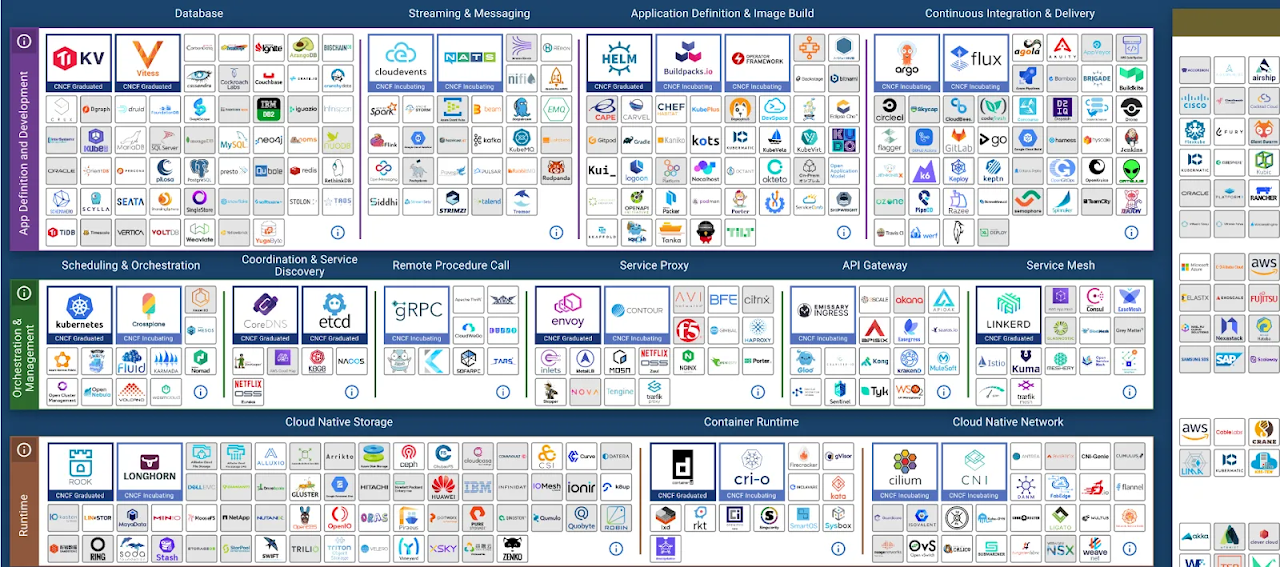
These pillars are not isolated concepts; they are woven together into a web that shapes the way we design and manage systems in the cloud.
Why does this matter?
Understanding the Cloud Native Landscape is not merely a technical matter. It is about developing a mindset that allows a professional to navigate an environment in which rapid change and constant innovation are the norm. Knowing how these disciplines interact, and where to apply them, is what separates an average professional from an expert.
For example, by bringing together technologies such as Kubernetes and Terraform, an architect can not only build scalable infrastructure but also ensure that it is managed efficiently and securely. Likewise, by combining observability with cybersecurity, it is possible to build systems that not only meet the needs of the business but also ensure compliance and protection against threats.
Shaping the learning path
For those who are just starting out or who wish to specialize in the field, it is essential to understand how the different disciplines of the Cloud Native Landscape are interconnected. This integrated view helps you prioritize both learning and practical application.
Cloud Fundamentals: Before moving on to complex technologies, it is essential to master the basics, such as service models (IaaS, PaaS, SaaS) and the main cloud providers.
Modern Development Practices: Understand how programming languages and modern architectures, such as microservices, influence the design of cloud-native systems.
Automation and Orchestration: Master the tools that automate processes and streamline software delivery, such as CI/CD and containers.
Specialization and Certification: Take part in certification programs to validate your skills, such as AWS Certified Solutions Architect or Kubernetes Certified Administrator.
Connecting knowledge to practice
In the day-to-day work of the profession, knowledge is never applied in isolation. Real projects frequently demand a combination of technologies and disciplines to meet the needs of the market. That is why constant practice, in real or simulated scenarios, is indispensable.
In the end, the goal is to develop professionals capable of designing, building, and maintaining systems that not only keep pace with technological innovation but also deliver value to the business. It is this combination of technical mastery, strategic vision, and adaptability that defines a true cloud-native software architect.
So, after all, what should I focus on?
The magic of containers and orchestration Let’s start with containers, which have become practically synonymous with cloud computing. You cannot talk about Cloud Native without mentioning Docker, the technology that lets you build, deploy, and run applications in an isolated and portable way. The great thing about containers is that you package everything the application needs (dependencies, libraries, and so on) and can run it in any environment, with no surprises.
Now, if containers are the building blocks, Kubernetes is the conductor that orchestrates them all. With it, you manage clusters of containers, ensuring that your application scales automatically with demand. Imagine an e-commerce site that needs to prepare for the traffic spike of Black Friday. With Kubernetes, the system can adjust fluidly, ensuring that the end user notices no drop in performance.
In practice, this means that to be a good cloud software architect, you must master not only how to build containers but also how to orchestrate them. The world of microservices and containers can be complex, but once you get the hang of it, it opens up a world of possibilities.
Infrastructure as Code: automating everything You know that moment when you look at that pile of servers, networks, and databases and think: “There has to be an easier way to manage all this”? Well, there is. That is where Infrastructure as Code (IaC) comes in, one of the most powerful tools in this landscape. Tools such as Terraform or AWS CloudFormation let you define your entire infrastructure in code and automate the creation and management of environments.
Imagine that you need to set up the same production environment for different teams. Doing it by hand would be an enormous headache. With Terraform, you write the code once and apply it to any environment. It is that simple.
Besides being a real lifesaver, IaC brings consistency. You eliminate the risk of “wrong manual configurations” that, sooner or later, cause some problem in production.
Microservices: pieces that move independently Remember when everything was built as large blocks of code, the famous monolithic systems? If one piece failed, the whole system went down with it. Today we live in an era in which microservices take center stage. By splitting an application into small, independent services, you can develop, deploy, and scale each one separately.
This has a direct impact on the agility and scalability of systems. Think of a streaming platform. You might have one microservice just for user authentication, another for managing videos, and a third for payments. If the payment service needs more resources during a usage spike, you can scale it independently of the other services.
On the learning path to becoming a cloud software architect, you need to understand not only how these microservices work but also how to integrate them efficiently and securely. And that brings us to the next point.
DevOps and Automation: bringing development and operations together One of the great secrets to succeeding with cloud-native applications is mastering DevOps practices. Here, the goal is clear: deliver faster, with fewer errors, and in an automated way. Automating CI/CD (Continuous Integration and Continuous Delivery) pipelines is an essential part of that equation.
With tools such as Jenkins, GitLab CI, or AWS CodePipeline, you can automate the development lifecycle, from the code commit to the production deployment. This means every new feature goes through automated tests and is deployed with no need for manual intervention. And yes, that makes all the difference when the goal is to scale your application and ensure everything runs without interruption.
Cloud Security: the foundation of everything Everything I have discussed so far — containers, IaC, microservices — only works well if security is in order. In the cloud, this involves a series of measures that ensure your infrastructure and applications are protected against vulnerabilities.
AWS IAM (Identity and Access Management), for example, is one of the most powerful tools when it comes to access control. It lets you define precisely who can access what, when, and how. A company that handles sensitive data, such as a fintech, must ensure that only the right people have access to the right information. A mistake here can be costly, both financially and to the company’s reputation.
Mastering these security concepts is essential for any cloud software architect. After all, building scalable and flexible solutions is great, but without security, all that effort can go down the drain.
Final thoughts
Navigating the Cloud Native Landscape may seem daunting at first, but as you understand how each discipline connects to the others, everything begins to make sense. Each piece — containers, IaC, microservices, DevOps, and security — has its role, and together they form the foundation on which cloud software architects can build modern, scalable, and secure solutions.
If you are on this journey, my advice is: dive deep into each of these areas, explore the tools and, above all, practice. The market is full of opportunities for those who master this ecosystem, and being well prepared will put you ahead.
And if you want to learn more about building a career in Cloud-Native Software Architecture, take a look at the article “How to Build a Career in Cloud-Native Software Architecture”.
References
[1] Cloud Native Computing Foundation (CNCF): Official documentation on the Cloud Native Landscape, including tools and practices. Available at:https://cncf.io/
[2] Docker: Official usage guide and best practices. Available at: https://docs.docker.com/
[3] Kubernetes: Official documentation for container management and orchestration. Available at: https://kubernetes.io/docs/
[4] Terraform: Official guide to infrastructure-as-code automation. Available at: https://developer.hashicorp.com/terraform/docs
[5] AWS CloudFormation: Technical reference for infrastructure configuration. Available at:https://aws.amazon.com/cloudformation/
[6] Prometheus: Monitoring and alerting tool for modern systems. Documentation available at: https://prometheus.io/docs/
[7] Grafana: Tool for visualizing data and metrics. Official documentation at: https://grafana.com/docs/
[8] AWS Lambda: Official guide to serverless platforms. Available at:https://aws.amazon.com/lambda/
[9] Google Cloud Functions: Technical reference for serverless computing. Available at: https://cloud.google.com/functions
[10] DevOps Handbook: Gene Kim, Patrick Debois, John Willis, and Jez Humble. A book that explores DevOps practices and their application in the cloud.
[11] Cloud-Native Architecture - CESAR School course: Academic content and applied projects. Available at:https://www.cesar.school/
[12] OWASP Foundation: Security guidelines for applications and infrastructure in the cloud. Available at:https://owasp.org/
[13] Kubernetes Certified Administrator (CKA) certification: Preparation guide. Available at: https://training.linuxfoundation.org/certification/certified-kubernetes-administrator-cka/
[14] AWS Certified Solutions Architect: Certification for solutions architects on AWS. Available at:https://aws.amazon.com/certification/certified-solutions-architect-associate/
Comments
Every comment is moderated before it appears here. Nothing is published automatically.
Loading…