 CARLOS DIEGO C. P.
Essay · Sciences
Technology, the Hottest New Sensation of the Summer
Keywords
"I will not instigate revolution"
In episode 6 of the first season of “The Simpsons,” Bart writes on the chalkboard: “I will not instigate revolution.” I hope to do the same in this piece — especially as I am about to talk about something society loves to exalt with enthusiasm: technology. “What do you mean? I’m sensing some irony there, Diego…” Absolutely! Let’s take it one step at a time.
The Simpsons is an American animated series created by Matt Groening in 1989. For those who don’t know (where have you been?), the show portrays a family made up of Homer, Marge, Maggie, Bart and Lisa. Across its countless seasons since it first aired, The Simpsons has always been remembered for an almost supernatural ability: predicting the future.

Trump as president of the United States, Brazil getting thrashed by Germany in the World Cup final, autocorrect, uprisings over alleged election fraud, 3D printers, and so many more: the show’s episodes have made a long list of successful predictions. The most recent of them: Apple’s augmented reality headset, the now-famous Vision Pro. Last week, Apple announced its new gadget, which was received almost as if Queen Elizabeth II had been reborn as a pop star and was singing a duet with Taylor Swift. With a little more attention, it would surely have been crowned queen of a drum section at Rio’s Carnival. Pure pomp! And, much the way we in Recife greet a new nightclub, it was received with great enthusiasm, with huge lines of curious people trying to get their hands on one and many proudly flaunting the title of “VIP Early Adopter.”
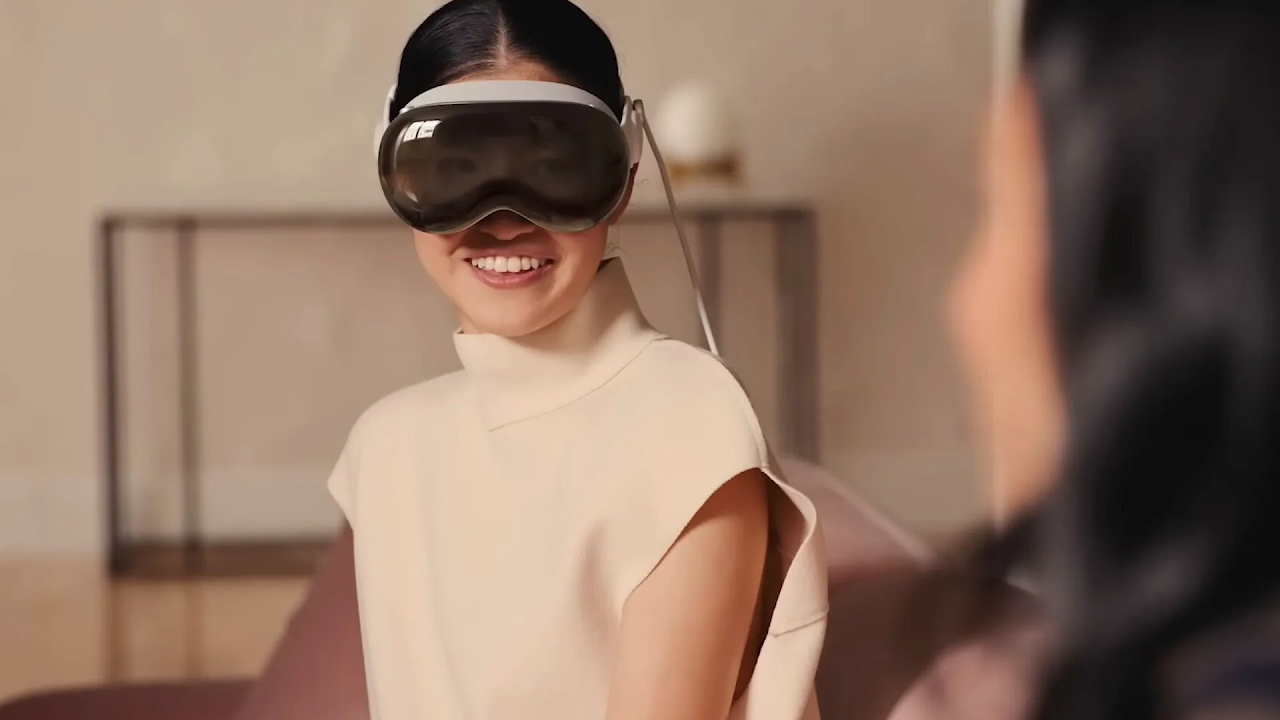
_Apple Vision Pro launches (https://www.cnnbrasil.com.br/tecnologia/apple-divulga-data-de-lancamento-dos-oculos-vision-pro-nos-eua-veja/)_ But back to The Simpsons: once again, they got it right. In the episode titled “Friends and Family,” which aired in 2016, the show depicts people’s chaotic reactions to using the gadget. Several tragicomic scenes from that episode show the characters wearing headsets while stumbling clumsily down the street, walking face-first into lampposts or falling into holes — setting the tone for what was to come.
<!-- embed: https://www.youtube.com/embed/ukmkjARRwwg -->
The longer the story, the more complex the plot
While writing this piece, I went looking for information about The Simpsons and came across a phrase in its synopsis that caught my attention: “… a portrait of a dysfunctional family…”. David Crouch and James Masteller, in the book “Perdoar nossos pais, perdoando a nós mesmos” (Forgiving Our Parents, Forgiving Ourselves), set out what characterizes a dysfunctional family:
"A dysfunctional family is one in which problems, conflict and even mistreatment among its members are frequent, occurring regularly and continuously. This ends up making the other members grow used to such situations. Sometimes children grow up in this environment and believe this kind of life together is normal. These families usually have adults who depend on one another in unhealthy ways, and they may also struggle with addiction, such as alcohol or drugs. Other causes include untreated mental illness and parents who reproduce the dysfunctional behavior of their own parents, or do exactly the opposite of what their parents did. In some cases, a parent who is not mature enough may allow another family member to abuse their children."
I don’t know about you, but when I read this account, what immediately comes to mind is how far this portrait might extend — not only to particular households but, by consequence and to some degree, to society as a whole. And let me be clear: I am not condemning an entire society, nor am I joining any “I love dogs more than people” campaign. Easy now — the saint on this float is made of clay… But I do catch myself wondering how widely this notion of dysfunction might apply.
Going further, I also wonder whether The Simpsons’ relative success at “predicting the future” owes something to its writers’ remarkable skill at observing and portraying the dysfunction of our own society. After all, let’s agree that once a story begins to unfold, depending on its elements, the ending is often not that hard to guess. Naturally, the longer the story and the more complex the plot, the more observation and the greater the capacity for abstraction it takes to arrive at an understanding that borders on futurism. Who doesn’t remember Captain Nascimento offering his futuristic reading of the ill-fated BOPE operation ahead of Pope John Paul II’s visit to Rio de Janeiro?

Reality through other eyes
The Greek philosopher Plato, in his allegory of “The Cave,” tells the story of people chained inside a cave who see only shadows cast on the wall and believe that this is the only reality. Then one of them escapes, discovers the truth outside the cave and tries to free the others, but is taken for a madman. Plato theorizes in his allegory that human life is but a fragment of reality, and that truth goes beyond the physical, stretching infinitely through time and across different dimensions of life, with the immortal soul surviving cycles of life and death.
Even though my entire academic and professional background rests on the study and practical application of technology and computing, I have always seen it as a means and not as an end in itself. As far as possible, I try to keep to a minimum the creation of what Plato called “fragments of reality.” Yes, I use social media and recognize its value in connecting people, but it certainly should not be our primary means of connection. Yes, I have a cell phone and recognize its value for communication, but I prefer — and recognize the fundamental value of — communicating in person. Nothing like shaking someone’s hand and making yourself understood. Communication is not only about the message, but about how that message is conveyed in all its nuances.
So I think that, while we are still learning about the benefits — and the harms — of technologies such as cell phones, social media and the like, yet another variable is being added to the equation, one that amplifies all the previous ones, on the premise that this amplification exists only for their benefits, utterly subjugating their harms. In “A fábrica de cretinos digitais — Os perigos das telas para nossas crianças” (The Digital Cretin Factory: The Dangers of Screens for Our Children), Michel Desmurget analyzes the enormous damage done to children by the excessive use of phone and tablet screens — yes, excessive, not mere use:
Digital natives are the first children to have a lower IQ than their parents. After thousands of years of evolution, human beings are now regressing in cognitive terms and in intellectual ability — because of excessive exposure to screens. The amount of time the new generations spend interacting with smartphones, tablets, computers and television is extremely high. By age 2, children in Western countries devote almost three hours a day to screens. Between ages 8 and 12, that time rises to about four hours and forty-five minutes. Between 13 and 18, exposure averages six hours and forty-five minutes a day. On a yearly basis, that comes to about a thousand hours for a child in the early years of elementary school (almost as many hours as a full school year) and 1,700 for one in the upper elementary grades. For middle and high school students, we are talking about 2,400 hours a year, the equivalent of a year and a half of full-time work. Contrary to what was once believed, the profusion of screens our children are exposed to is far from improving their abilities. In fact, precisely the opposite is true: it carries heavy consequences for their health (obesity, the development of cardiovascular disease and reduced life expectancy), for their behavior (aggressiveness, depression, anxiety) and for their intellectual abilities (language, concentration and memory). All of this seriously affects young people’s academic performance and their development.""
“Even goodness, grown to excess, dies of its own too much”
And before the crowd at the extremes chimes in with “aha, so it’s better to have zero screens!”, I would turn to Shakespeare, who wisely spoke of excess: “even goodness, grown to excess, dies of its own too much.” Complete deprivation would carry the obvious consequence of leaving a person oblivious to the reality around them and, at the very least, of depriving them, above all, of knowing how to deal with the features of that very reality — even if only to oppose it. So it all comes down to balance.
“Peace is neither waiting nor rest. It is a balance sustained in motion, one that constantly unfolds energies of spirit and of action. It is an intelligent and living force. To say yes to peace is to say yes to God.” Paul VI Although I am indeed a technology enthusiast and recognize its profound value across the most diverse fields of our society and modern civilization, I am not thrilled by announcements like the Vision Pro. In fact, I view it with reservations, since it creates even more intense simulacra than the ones our society already has — social media, metaverses and the like. I view it with little enthusiasm because I believe creations like this end up driving us even further from what truly makes us human: real, ongoing and — why not say it — necessary interactions. How many social situations have you endured against your will that, in the end, brought you a new connection, a friendship or even a relationship? Believe me, I am far from a model of sociability, but I deeply recognize its necessity and its benefits. After all, as Aristotle would say: “Man is a social animal.”
Let us wait and see how augmented reality devices, virtual reality devices — or whatever other euphemism justifies a “cooler, hipper new way to interact with reality” — play out. But, just as Groening scripts in The Simpsons, the symptoms are a clear indication of what we can expect to happen. Or, more bluntly, as Captain Nascimento would say: “I already warned you this is gonna go to sh1t…”.
References
[1] Groening, Matt. The Simpsons. Animated series, 1989.
[2] Crouch, David; Masteller, James. Perdoar nossos pais, perdoando a nós mesmos. Editora Vida, 2005.
[3] Plato. "The Allegory of the Cave". The Republic.
[4] Desmurget, Michel. A fábrica de cretinos digitais: Os perigos das telas para nossas crianças. 2019.
[5] Shakespeare, William. Measure for Measure.
[6] Paul VI. Message for the World Day of Peace, 1972.
[7] Aristotle. Politics.
[8] CNN Brasil. "Apple divulga data de lançamento dos óculos Vision Pro nos EUA". Available at:https://www.cnnbrasil.com.br/tecnologia/apple-divulga-data-de-lancamento-dos-oculos-vision-pro-nos-eua-veja/.
Comments
Every comment is moderated before it appears here. Nothing is published automatically.
Loading…